A storm damage roof inspection starts on the ground, not on a ladder. Once the storm has passed and the power lines are clear, walk around the house, check the gutters, downspouts and anything metal for hail marks, look for missing or lifted shingles, then go into the attic with a flashlight. Photograph everything before you clean up, call your insurer, and leave the climbing to a licensed roofer.
Safety first: inspect from the ground
The urge to climb up and look is strong after a loud night of hail or wind. Resist it. The National Roofing Contractors Association (NRCA) strongly encourages homeowners to assess roof damage from ground level and not to attempt repairs on their own, and it says closer assessment and repairs should be done by a professional roofing contractor.
The Asphalt Roofing Manufacturers Association (ARMA) puts it even more plainly: homeowners should not climb onto their roofs. Roofing is a trade with its own fall-protection rules for a reason.
Wait until the storm has fully passed
Ready.gov, the preparedness site run by FEMA, tells people to follow authorities and forecasts on whether it is safe to go outside, and to watch for fallen power lines and trees.
If a line is down near your gutters, a fence or a puddle, stay away and report it to the utility. Ready.gov's tornado guidance says to stay clear of fallen power lines or broken utility lines, and to wear thick-soled shoes, long pants and work gloves during clean-up.
Why a wet or damaged roof is the wrong place to be
Falls are the leading cause of death in construction, according to OSHA. In 2024 there were 389 fatal falls to a lower level out of 1,034 construction fatalities, based on Bureau of Labor Statistics data. Those numbers involve trained workers, many with harnesses and anchors.
OSHA treats anyone working six feet or more above a lower level as at risk of serious injury or death in a fall. On a roof, it points to hazards such as holes, skylights and leading edges. After a storm, add wet granules, loose shingles, torn underlayment and debris, and a homeowner on a ladder has very little margin.
Tools for a ground-level inspection
You can see a surprising amount without leaving the ground. Gather a few things before you start:
- Binoculars, or a phone with a good zoom lens, to scan each roof slope from the yard and from across the street.
- A phone or camera that records the date and time on each photo.
- A strong flashlight for the attic and for dark corners under the eaves.
- A tape measure or ruler for any hailstones still on the ground and for dents in soft metal.
- A notepad, or a notes app, to list what you see in each area of the house.
- Gloves and closed shoes for walking through debris.
Check what the storm actually delivered
Before you judge the roof, find out how strong the storm was at your address. Insurers and roofers both look at hail size and wind speed, and the official record gives your claim context.
The National Weather Service (NWS) calls a thunderstorm severe when it produces hail one inch in diameter or larger, roughly the size of a U.S. quarter, or winds of 58 miles per hour or greater. NOAA's National Severe Storms Laboratory classifies damaging winds as those exceeding 50-60 mph, and notes that thunderstorm wind speeds can reach up to 100 mph.
| NWS warning level | Hail size | Wind speed | What it means for a roof |
|---|---|---|---|
| Severe (base) | 1 inch (quarter) or larger | 58 mph or greater | Worth a full ground-level inspection, especially on older shingles |
| Considerable damage threat | At least 1.75 inch (golf ball) | At least 70 mph | Dents in gutters and vents are likely; call a roofer for a close look |
| Destructive damage threat | At least 2.75 inch (baseball) | At least 80 mph | Expect visible roof, window and siding damage; document and report quickly |
The NWS says that on average only 10 percent of all severe thunderstorms reach the destructive category each year, nationwide. Most storms that damage roofs fall in the lower two rows.
Measure hail while it is still on the ground
If hailstones are still lying in the yard, measure a few of the largest and photograph them next to a ruler. NOAA's storm laboratory says estimates that compare hail to a known object are good, but measurements with a ruler, calipers or a tape measure are better.
Size matters because larger stones hit harder. NOAA estimates that hailstones of 1 inch to 1.75 inches fall at 25 to 40 mph, while stones of 2 to 4 inches in the strongest supercells fall at 44 to 72 mph. Strong surface winds can also drive hail at an angle or nearly sideways, which is why one side of a house often takes more damage than the other.
Find the official storm reports
NOAA keeps official hail and wind records in its Storm Events Database, and local NWS offices publish storm reports after major events. Save a copy or a screenshot of any report near your address with the date of the storm.
Hail is common across much of the country. The Insurance Information Institute (Triple-I), citing NOAA's Storm Prediction Center, reports 5,432 hail events in 2025 compared to 5,373 in 2024, with Texas and Kansas recording the most.
What hail damage looks like
The Insurance Institute for Business & Home Safety (IBHS) says hail can occur in any strong thunderstorm, which makes it a threat everywhere, and that hail damage to a roof covering can shorten its life and may require repair or replacement. The trick is telling real hail hits apart from ordinary aging.
Start with collateral damage
IBHS recommends checking the softer, easier-to-see surfaces first. Look for spatter marks or impact dents on air conditioning units, gutters, metal flashing, downspouts and even patio furniture.
According to IBHS, collateral damage confirms a hail event occurred, which helps distinguish hail damage from normal wear and tear. If the metal around the house is clean and undented, widespread hail damage to the shingles is less likely.
Signs of hail on asphalt shingles
Once collateral damage is confirmed, IBHS lists three indicators on the shingles themselves. The first is a random pattern of impact marks, rather than a line or a cluster that follows foot traffic.
The second is bruising: soft spots you can feel when pressing on the shingle. The third is cracks or breaks in shingles where hail has struck. IBHS adds that ridge caps are especially vulnerable on an asphalt shingle roof, so they are a good place for a roofer to look first.
In the lab, IBHS describes three ways hail affects an asphalt shingle: it can dent the shingle, breach or tear it, or displace its granules. Severe damage can create the potential for water entry.
Look-alikes that are not hail damage
Finding loose granules in the gutter can be worrying, but IBHS cautions that seeing some granules come off your shingles does not mean there is hail damage. Heavy rain can knock granules off too.
IBHS lists other common look-alikes: granule loss along the edge of shingles from natural weathering, uniform wear or discoloration, manufacturer defects, and marks from installation, tools or other man-made damage. A pattern that matches the whole roof usually points to age, while scattered fresh hits point to the storm.
Metal, tile and other roof coverings
Not every roof reacts the same way. IBHS says large hail may crack or shatter tile, depending on its thickness, material and where it is struck.
Metal roofs tend to dent. IBHS notes that while dents change the appearance of a roof, there is currently no evidence that dents impact the function of the roof. That distinction can matter on an insurance claim, since some policies treat cosmetic metal damage differently, so read your policy wording.
What wind damage looks like
Wind damage is more common than many people assume. NOAA says damage from severe thunderstorm winds accounts for half of all severe reports in the lower 48 states and is more common than damage from tornadoes.
IBHS explains that wind exploits vulnerabilities in roof covers, which often begins a cascade of damage because of the water that can follow. When wind blows across a roof, it acts to suck the roof up and off the building.
Lifted, curled and missing shingles
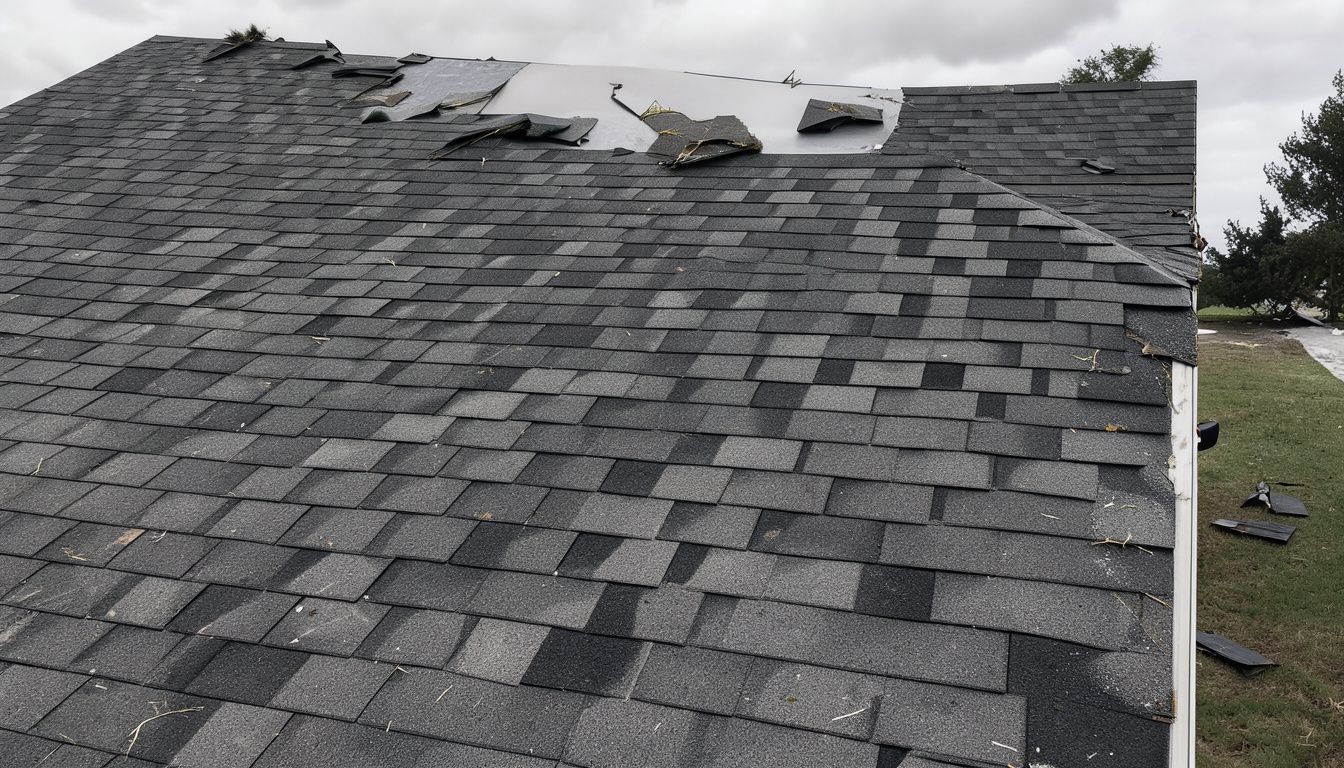
On an asphalt roof, the adhesive strip under each tab is what holds it down against that suction. IBHS describes how, once one shingle tab fails, it can start a cascade that rips off other shingles and exposes neighboring ones to forces they are not designed to withstand.
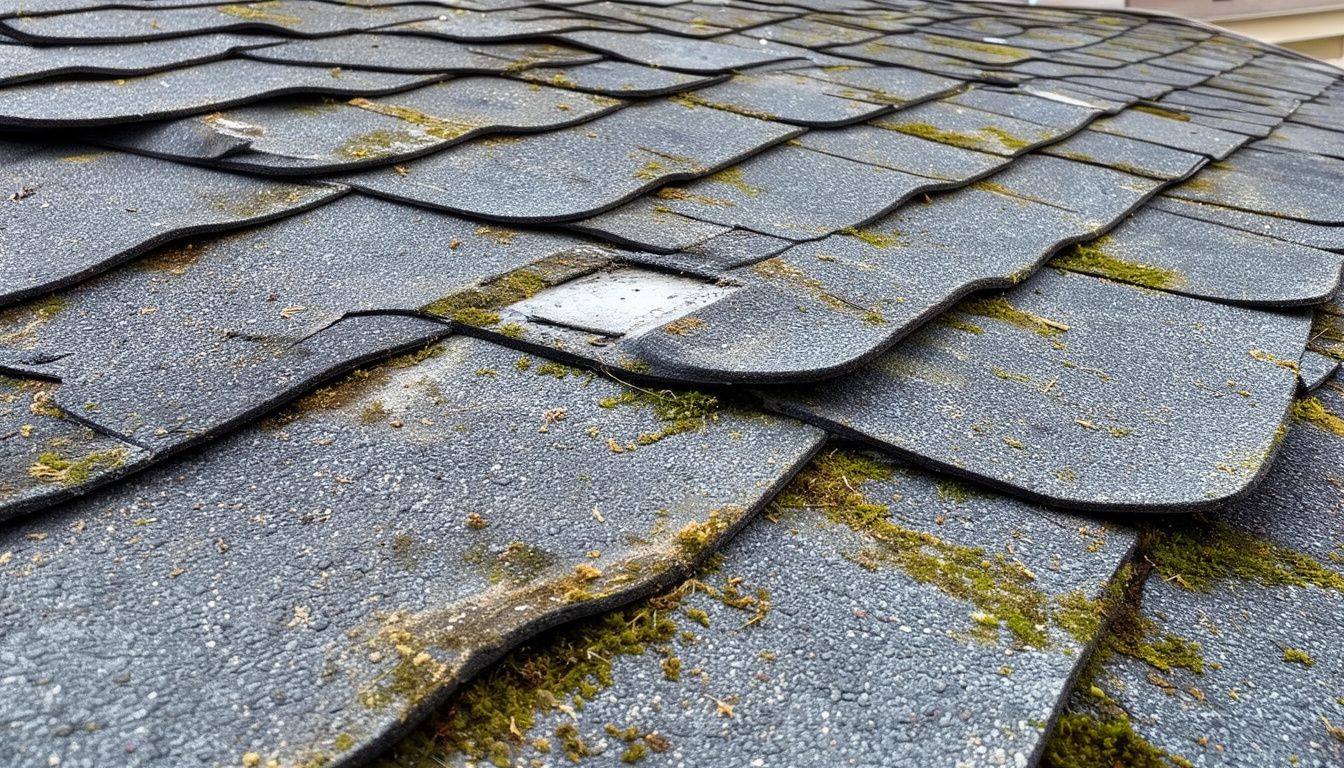
From the ground, look for tabs that sit higher than their neighbors, shingles that are folded back or missing, and bare patches of underlayment or wood. IBHS notes that once shingles fail, the underlayment is exposed to wind loads it is typically not designed to withstand.
Why older roofs lose more shingles in wind
Shingle sealant does not stay strong forever. IBHS reports that after 7-10 years, the sealant weakens enough to significantly reduce a shingle's ability to resist wind pressure, and some tabs may become unsealed and offer no resistance at all.
IBHS also says the edges of asphalt shingle tabs may begin to peel up and curl with time. The good news is that when an asphalt shingle roof becomes unsealed, a roofer may be able to reseal the shingles with additional sealant instead of replacing them.
Debris and fallen limbs
High winds turn branches, fencing and outdoor furniture into projectiles. A heavy limb can puncture the deck or crack rafters even when only a few shingles look disturbed from below.
If a tree or large branch is resting on the roof, do not try to remove it yourself. Call a tree service and a roofer, and photograph it in place first, since the insurer will want to see how it landed.
Hail vs. wind damage: how to tell them apart
Many storms bring both, and an adjuster will try to separate them. This side-by-side summary draws on IBHS and NOAA guidance.
| What you see | Points to hail | Points to wind |
|---|---|---|
| Pattern on the roof | Random impact marks spread across a slope | Damage concentrated on edges, ridges and the side facing the storm |
| Shingle surface | Bruises (soft spots), cracks at impact points, displaced granules | Lifted, curled, folded back or missing tabs |
| Metal around the house | Spatter marks and dents on gutters, vents, A/C units and downspouts | Bent or loose flashing, gutters pulled away from the fascia |
| Ground clues | Hailstones, shredded leaves, dented patio furniture | Shingle pieces in the yard, broken limbs, displaced outdoor items |
| Siding and windows | Chips or holes, worse on the windward side when hail is wind-driven | Loose or missing siding panels and trim |
| Common look-alike | Edge granule loss and uniform wear from age | Tabs that unsealed slowly with age before the storm |
The storm damage roof inspection checklist
Work through the house in the same order every time, and write down what you find in each area. Take a wide photo of each area first, then close-ups of anything that looks wrong.
From the ground
- Walk all four sides of the house and scan each roof slope with binoculars or a zoom lens.
- Look for missing shingles, exposed underlayment or bare wood.
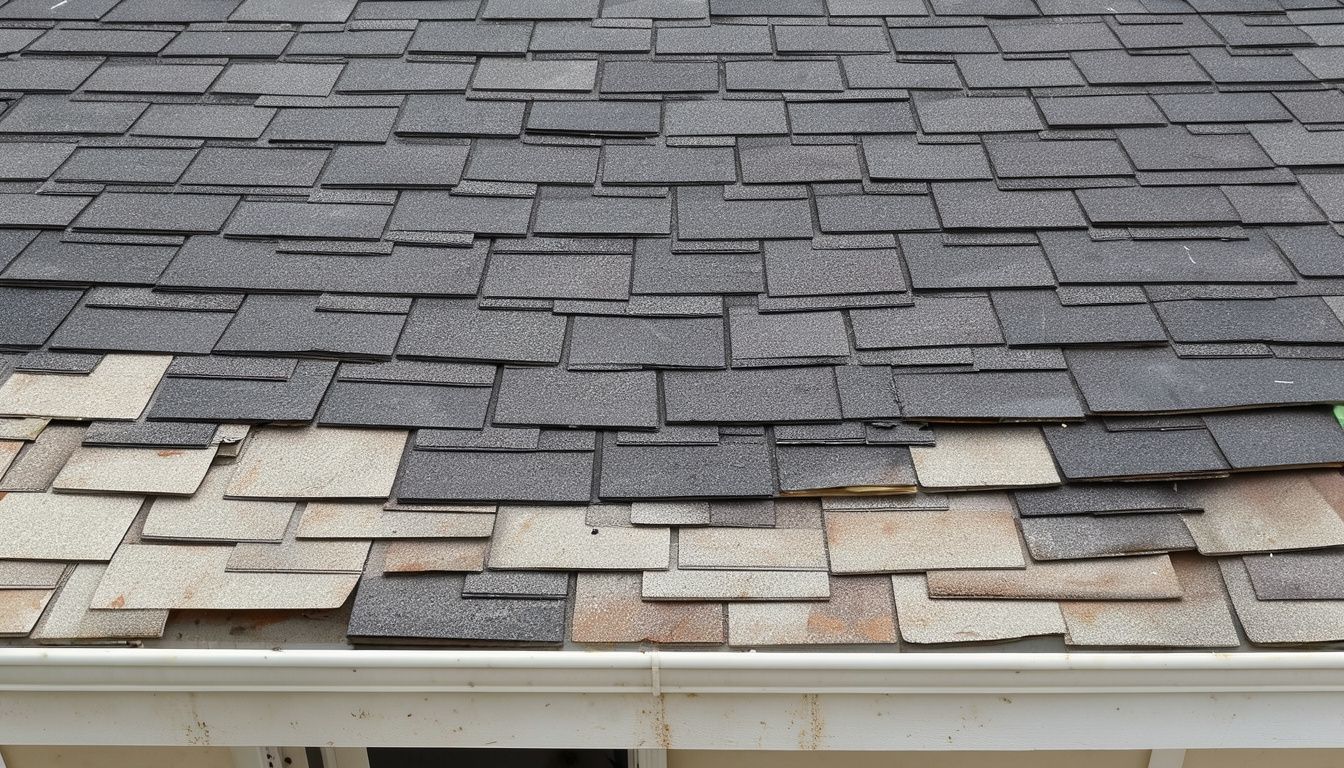
- Look for tabs that are lifted, curled, folded back or out of line with the rows around them.
- Check the ridge caps along the peak for cracks or missing pieces.
- Look for branches, limbs or other debris resting on the roof or in valleys.
- Check for sagging or uneven sections of the roofline, which can signal structural damage.
- Pick up and photograph any shingle pieces found in the yard.
Gutters and downspouts
- Check gutters, downspouts and gutter guards for dents and spatter marks, which IBHS treats as collateral evidence of hail.
- Look for sections that are bent, cracked or pulled away from the fascia board.
- Note heavy deposits of granules at downspout outlets, but remember that heavy rain and age also shed granules.
- Look for clogs of leaves and branches; ARMA recommends keeping gutters and roof valleys clear so they are not clogged with leaves, branches or litter.
- Check that downspouts still discharge away from the foundation.
Attic and ceilings
- Inspect interior ceilings and walls, especially on the top floor, for new water stains, bubbling paint or sagging drywall.
- In the attic, shine a flashlight along the underside of the roof deck. ARMA notes that active leaks can be revealed this way during a rainstorm.
- Feel insulation near the eaves, chimney and vent pipes for dampness.
- Look for daylight through the deck boards, wet or darkened wood, and drips along nails.
- Notice any musty smell, which can point to moisture that has been sitting for a while.
- Photograph every stain with something for scale, and note the room and ceiling location.
Flashing and vents
- Check the metal flashing around chimneys, skylights and where the roof meets a wall. ARMA notes that leaks can occur where roofs meet sidewalls and around penetrations such as skylights, vent pipes and chimneys.
- Look for flashing that is bent, lifted or pulled away from the surface.
- Check roof vents, ridge vents, exhaust caps and turbine vents for dents or missing parts. Soft metal shows hail hits clearly.
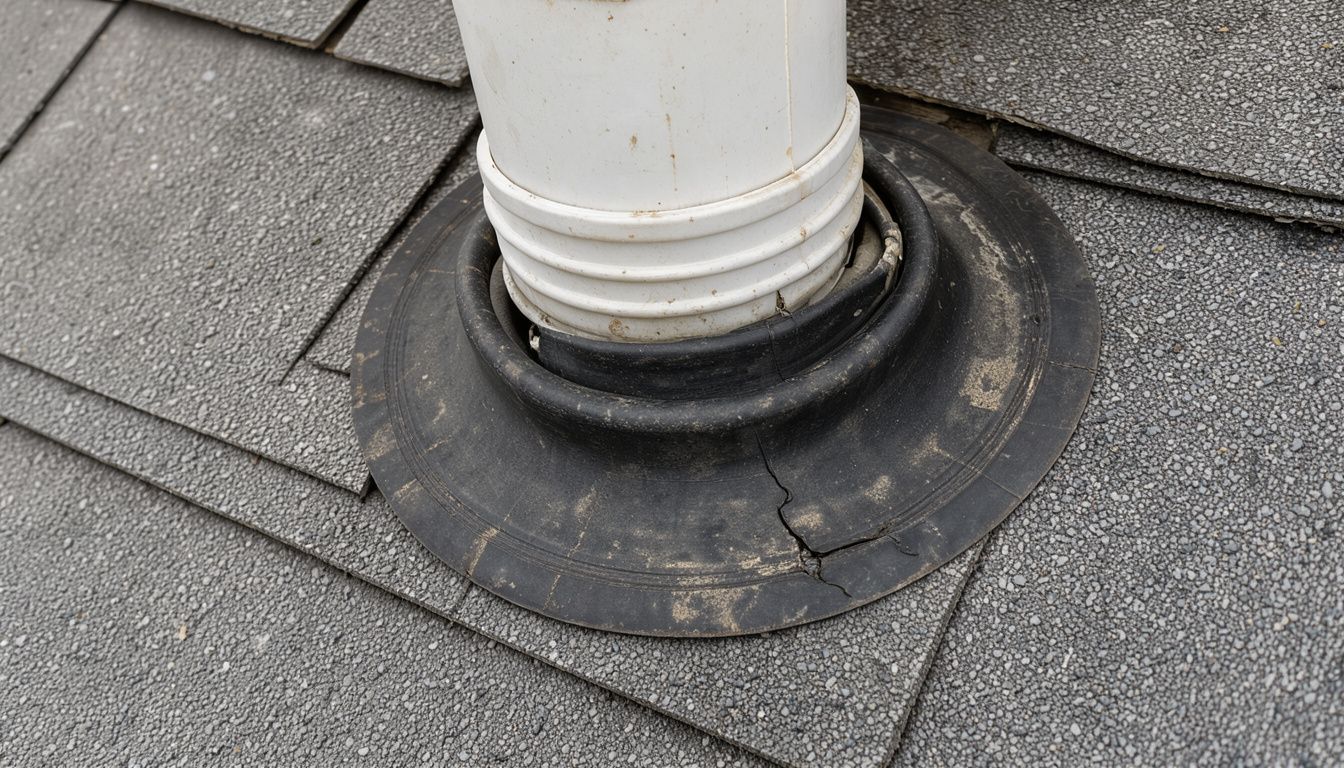
- Look at the rubber boots around plumbing vent pipes for tears.
- Check skylight glass and frames for cracks.
- Look at the chimney cap and crown for damage from falling limbs.
Around the house
- Check air conditioning units and their fins for dents; IBHS lists A/C units among the first places to look for hail.
- Inspect siding, window screens, window glass and trim, paying close attention to the side that faced the storm.
- Look at fences, mailboxes, decks, outdoor lights and patio furniture for spatter marks or dents.
- Check cars parked outside, since body dents help confirm the hail size at your address.
- Look at the fascia and soffit boards for cracks, holes or gaps.
- Note whether neighbors have similar damage, and photograph it from the street if it is visible.
Damage type vs. what to do next
Once your walk-around is done, match what you found to a next step. The repair notes below follow ARMA, IBHS and state insurance department guidance.
| What you found | What to do |
|---|---|
| Active leak or an opening in the roof | Protect the inside, photograph the damage, call your insurer, and have a roofer tarp the opening as a temporary repair |
| A few missing or broken shingles | ARMA says these should be individually replaced; get a repair estimate before deciding whether to file |
| Loose or lifted tabs with no tears | ARMA says loose tabs should be re-adhered; a roofer may be able to reseal them |
| Widespread missing or damaged shingles | ARMA notes this may indicate a need for reroofing; get an inspection and more than one estimate |
| Dents on gutters, vents and A/C units | Photograph them as collateral evidence, then have a roofer check the shingles for hail hits |
| Granules in gutters but no other signs | Do not assume hail; compare with the rest of the roof and ask a roofer to check for bruising |
| Tree or limb on the roof | Stay off the roof, photograph it in place, and call a tree service, a roofer and your insurer |
| Wet insulation or stains in the attic | Photograph them, note their location, and ask the roofer to trace the leak path from above |
Documenting roof damage for insurance
Wind and hail make up the largest share of homeowners claims. Triple-I reports that about one in 34 insured homes has a property damage claim related to wind or hail each year, and that from 2018 to 2022 wind and hail accounted for the largest share of claims, with 3.0 percent of insured homes having such a loss. Good records make that kind of claim much easier to settle.
Photos and video come first
Ready.gov tells disaster survivors to document any property damage with photographs. The Texas Department of Insurance (TDI) adds video, and recommends making a list of the damage inside and outside your house.
Shoot wide first, then close. A wide shot of each side of the house shows context; close-ups of dented vents, torn shingles, ceiling stains and measured hailstones show detail. Keep the original files with their date and time stamps, and do not edit them.
Keep damaged items and a written log
TDI says not to throw damaged items away until your insurance company tells you to. Set aside shingle pieces, broken screens and other debris in a dry place.
The Nebraska Department of Insurance recommends keeping a log of all communications, including names, dates and topics discussed. TDI similarly suggests keeping a list of everyone you talk to at your insurance company. Write down your claim number as soon as you receive it.
Temporary repairs vs. permanent repairs
You are generally expected to limit further damage. TDI tells homeowners to cover broken windows and holes to keep rain out, and to save all receipts because the policy may pay for temporary repairs. IBHS gives tarping exposed areas as an example of a reasonable temporary repair.
Hold off on permanent work. The Nebraska Department of Insurance says to make only temporary repairs to prevent additional losses and not to make any permanent repairs until an adjuster inspects the damage.
Meeting the adjuster
TDI recommends being available for the adjuster visit so you can make sure they see everything, and the Nebraska department suggests being present during inspections. Walk the adjuster through your photos and your list, including the attic.
If you hire a public adjuster to represent you, Nebraska advises verifying that they are licensed and reputable with the state insurance department. A contractor is not a substitute for a licensed adjuster.
Filing the claim: deadlines and deductibles
IBHS advises calling your insurance agent first to report suspected hail damage, and TDI says to file a claim as soon as you can if hail or strong winds damaged your home. Reporting early keeps your options open while the evidence is fresh.
How long you have to file
There is no single national deadline. The time limit is set by your policy and, in some cases, by state law, so look for a section titled something like "Duties after loss" or "Suit against us" in your policy.
Two state examples show how much rules vary. In Texas, policies from the Texas Windstorm Insurance Association must require you to file a claim no later than the first anniversary of the date the damage occurred. In Oklahoma, any policy with a time limit for wind or hail roof claims must allow filing up to 24 months after the date of loss if the damage is not evident without inspection. Check your own state insurance department's website for the rule where you live.
How wind and hail deductibles work
Many policies in storm-prone states use a percentage deductible for wind and hail instead of a flat dollar amount. The Texas Office of Public Insurance Counsel explains that the percentage is calculated on the amount of insurance you have on your home, not the amount of your claim.
Its example uses a home insured for $200,000. With a 1% deductible, the homeowner pays $2,000 of a $7,000 claim; with a 5% deductible, the homeowner pays the full $7,000 and the insurer pays $0. Look at your declarations page before you decide whether a small repair is worth a claim.
How claims are paid
The Nebraska Department of Insurance notes that payments for the structure may include your mortgage company and be released in stages. That is normal, and it is one more reason to keep every estimate, invoice and receipt in one folder.
When you replace the roof, ask about impact-rated shingles. IBHS points to products tested to UL 2218 or FM 4473 standards for hail resistance, and Nebraska notes that insurance companies may offer premium reductions for these resistant materials.
How to avoid storm-chaser contractors
Hail and wind bring out door-knockers within hours. The Federal Trade Commission (FTC) warns that unlicensed contractors and scammers often appear in recovery zones, and tells consumers to be skeptical of anyone promising immediate clean-up or repairs.
Red flags to watch for
- A stranger who knocks and offers to "take a look" at your roof. IBHS advises avoiding unsolicited offers to inspect or repair your roof, and HomeGuide warns about roofing scams that begin with an unsolicited no-cost inspection.
- Pressure to sign right away to lock in a special price, which the FTC lists as a scam tactic.
- A request to pay for everything up front, or to pay in cash, by wire transfer, gift card, payment app or cryptocurrency.
- An offer to waive or cover your deductible. TDI says it is illegal to waive a homeowners deductible under Texas law, and your insurer may ask for proof that you paid it.
- A request to sign over your insurance check. The FTC says never to sign your insurance check over to a contractor.
- A refusal to give you copies of a license, proof of insurance or a written contract, which the FTC calls a red flag.
- Anyone who charges a fee to help you apply for FEMA aid. The FTC notes that FEMA does not charge application fees.
How to check a roofer
IBHS recommends a licensed, bonded and insured professional with a local address, and suggests checking whether the roofer is an NRCA member or manufacturer certified. It also says to get multiple estimates and never give in to high-pressure sales tactics.
TDI suggests checking references and calling the Better Business Bureau to see whether a contractor has complaints. Make sure the roofer pulls any permits your city or county requires before work starts.
The contract and the estimate
The FTC says a written estimate should include a description of the work, the materials, the completion date and the price. Do not choose a bid on price alone; ask why two estimates differ if the gap is large.
TDI warns never to sign a contract that has blank spaces. If you sign at home rather than at the contractor's place of business, the FTC says the contract should include a written statement of your right to cancel within three business days.
Paying for the work
TDI tells homeowners not to pay in full up front, and the FTC notes that some states limit how much a contractor can ask for as a down payment. Pay by check or credit card so you have a record.
For larger jobs paid from an insurance settlement, the FTC suggests arranging a Certificate of Completion with your bank or credit union, so the contractor is paid for each stage only after you approve it. Never make the final payment until the work is done and you are satisfied.
When to call a roofer
Call a licensed roofer for a close inspection when your walk-around turns up any of the following:
- Missing shingles, exposed underlayment or an open hole in the roof.
- Dents on gutters, vents or A/C units after a storm with hail one inch or larger.
- Water stains, drips or wet insulation in the attic or on ceilings.
- Bent or lifted flashing around a chimney, skylight or wall.
- A tree or large limb on the roof, or a sagging section of the roofline.
- An older roof that has been through high winds, since IBHS says sealant strength drops significantly after 7-10 years.
The Oklahoma Insurance Department encourages homeowners to have their roofs inspected by a reputable expert once a year or after a major hail or wind event. A close inspection is the only way to confirm soft bruises, broken seals and deck damage that cannot be seen from the yard.
What storm repairs and inspections cost
HomeGuide puts the average roof inspection at $100 to $400, depending on roof size, complexity and whether it is a physical, infrared or drone inspection. HomeGuide also notes that an insurance company schedules its own no-cost inspection to investigate a claim, which may affect premiums and continued coverage.
For repairs, HomeGuide lists $150 to $1,000 for minor work such as small leaks or a few shingles, and $1,000 to $3,000 for moderate repairs. Repairs involving water damage range from $1,000 to $6,000 or more depending on severity, and roof vent repairs average $400 to $800.
Speed has a price. HomeGuide says emergency roof repair costs $200 to $300 extra, and an emergency roof tarp runs $1.00 to $2.80 per square foot for after-hours service that usually includes an evaluation, debris removal, photos for insurance and a repair estimate. If the damage is extensive, use our roof replacement cost calculator to compare a full replacement with the repair bids you receive.
Compare any estimate to your wind and hail deductible before filing. Triple-I data compiled by Verisk shows an average wind and hail claim of $15,708 over 2020 to 2024, so a large storm claim is common, but a two-shingle repair may cost less than your deductible.
Frequently asked questions
How do I check for roof damage after a storm without climbing on the roof?
Stay on the ground, as NRCA and ARMA both advise, and scan each roof slope with binoculars or a zoom lens. Check gutters, downspouts, vents and A/C units for dents, then look in the attic with a flashlight for stains or wet insulation. Leave any close inspection to a licensed roofer.
What size hail can damage a roof?
The National Weather Service treats hail one inch in diameter or larger, about the size of a quarter, as severe. There is no single size that always damages shingles, so IBHS recommends looking for collateral dents on gutters, vents and A/C units to confirm a damaging hail event before judging the roof.
Are granules in my gutters a sign of hail damage?
Not by themselves. IBHS says some granule loss does not mean there is hail damage, and that heavy rain and natural weathering along shingle edges also shed granules. Look for a random pattern of impact marks, soft bruises and cracks on the shingles, which a roofer can confirm.
What is the deadline to file a roof claim after hail or wind?
It depends on your policy and your state. Texas Windstorm Insurance Association policies require a claim by the first anniversary of the damage, while Oklahoma requires policies to allow filing up to 24 months after the loss when damage was not evident without inspection. The Texas Department of Insurance advises filing as soon as you can.
Should I let a contractor who knocks on my door inspect my roof?
IBHS advises avoiding unsolicited offers to inspect or repair your roof, and the FTC warns that unlicensed contractors and scammers often appear after storms. Choose a licensed, bonded and insured roofer with a local address, get more than one estimate, and never sign over your insurance check.
Can I fix the roof before the insurance adjuster comes?
You can and should make temporary repairs, such as tarping an opening or covering broken windows, and keep the receipts. The Nebraska Department of Insurance says not to make permanent repairs until an adjuster inspects the damage, and to photograph everything first.
Does a dented metal roof need to be replaced?
Not always. IBHS notes that dents change the look of a metal roof but that there is currently no evidence they affect how the roof performs. Check how your policy treats cosmetic damage, and have a roofer look at seams, fasteners and flashing.
Sources
- NRCA, nrca.net/news-events/press-room/storm-roof-repairs (read November 22, 2026)
- ARMA, asphaltroofing.org/readying-your-roof-for-extreme-weather-events/ (read November 22, 2026)
- OSHA, osha.gov/stop-falls (read November 22, 2026)
- Ready.gov (FEMA), ready.gov/tornadoes (read November 22, 2026)
- Ready.gov (FEMA), ready.gov/hurricanes (read November 22, 2026)
- Ready.gov (FEMA), ready.gov/thunderstorms-lightning (read November 22, 2026)
- National Weather Service, weather.gov/bmx/outreach_svr (read November 22, 2026)
- National Weather Service, weather.gov/lot/SevereThunderstormWarningsUpdate (read November 22, 2026)
- NOAA National Severe Storms Laboratory, nssl.noaa.gov/education/svrwx101/wind/ (read November 22, 2026)
- NOAA National Severe Storms Laboratory, nssl.noaa.gov/education/svrwx101/hail/ (read November 22, 2026)
- NOAA National Severe Storms Laboratory, nssl.noaa.gov/education/svrwx101/hail/faq/ (read November 22, 2026)
- IBHS, ibhs.org/is-it-hail-damage/ (read November 22, 2026)
- IBHS Roofing Roadmaps, ibhs.org/roof-roadmaps-copy/ (read November 22, 2026)
- Insurance Information Institute (Triple-I), iii.org/fact-statistic/facts-statistics-homeowners-and-renters-insurance (read November 22, 2026)
- Insurance Information Institute (Triple-I), iii.org/fact-statistic/facts-statistics-hail (read November 22, 2026)
- Nebraska Department of Insurance, doi.nebraska.gov/node/2204 (read November 22, 2026)
- Texas Department of Insurance, tdi.texas.gov/tips/after-hail-or-windstorms.html (read November 22, 2026)
- Texas Insurance Code § 2210.205, texas.public.law/statutes/tex._ins._code_section_2210.205 (read November 22, 2026)
- Oklahoma Insurance Department, oid.ok.gov/bulletin-4-2022/ (read November 22, 2026)
- Texas Office of Public Insurance Counsel, opic.texas.gov/news/decoding-deductibles/ (read November 22, 2026)
- HomeGuide, homeguide.com/costs/roof-inspection-cost (read November 22, 2026)
- HomeGuide, homeguide.com/costs/roof-repair-cost (read November 22, 2026)
- FTC, consumer.ftc.gov/articles/how-avoid-scams-after-weather-emergencies-and-natural-disasters (read November 22, 2026)